
Description
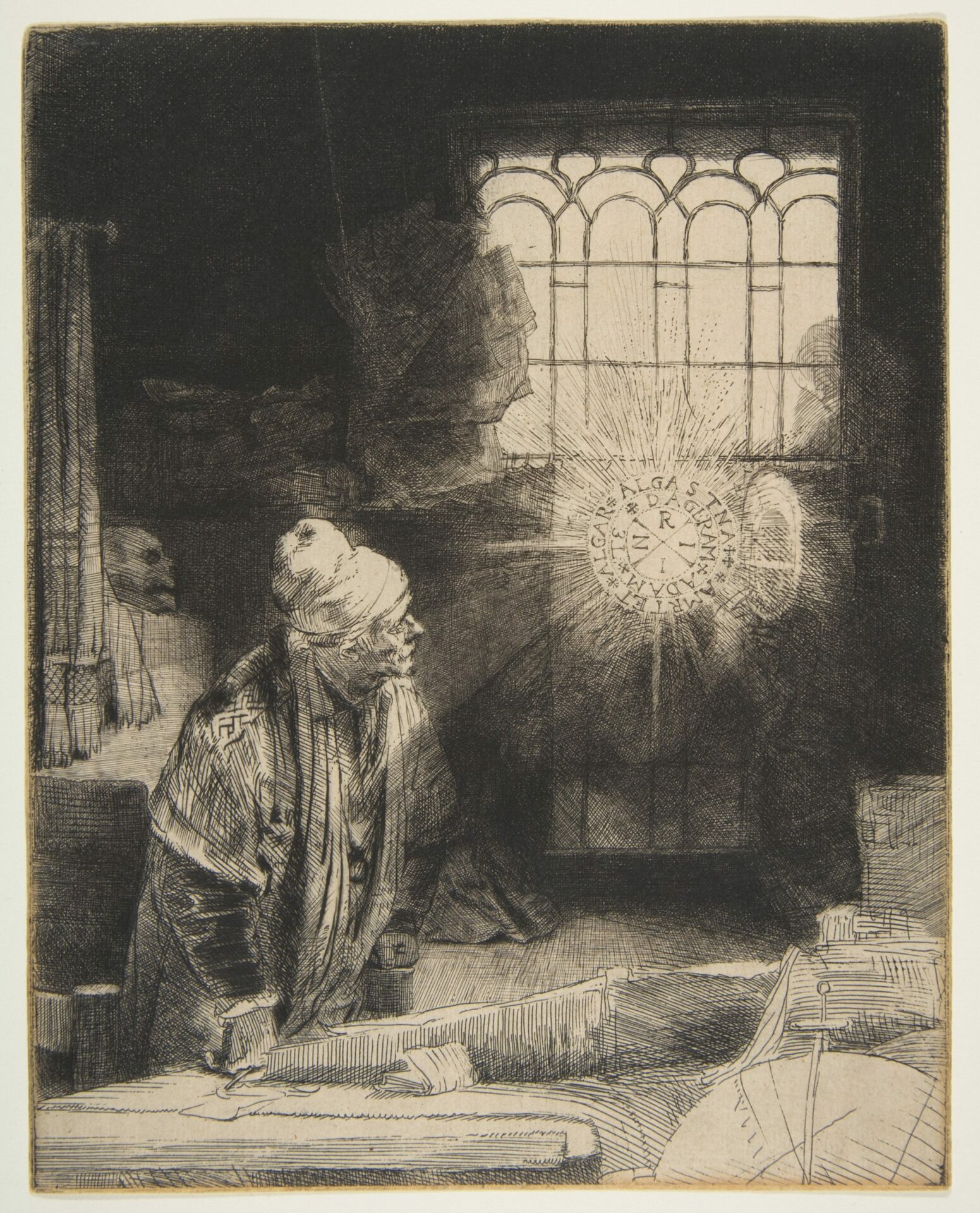
In Rembrandt’s print traditionally known as Faust, a scholar stands or leans beside a table at the left, turning toward a luminous circular form near the right-hand window. The bright disk interrupts the room’s darker tones, drawing attention away from ordinary furnishings toward an enigmatic appearance. Rembrandt gives the human figure and the unusual light a close relationship without making the surrounding space disappear.
Dated about 1652, the etching is represented in its first of seven states. The traditional title Faust leaves the precise identity of the scholar and the meaning of the scene open. Its visual power lies in the encounter between a concentrated human presence and a radiant form that resists a simple explanation. The contrast between the scholar’s space and the glowing window makes uncertainty part of the image’s lasting fascination.
Read our guide to giclée prints or browse the Rembrandt collection.

Reviews
There are no reviews yet.