Description
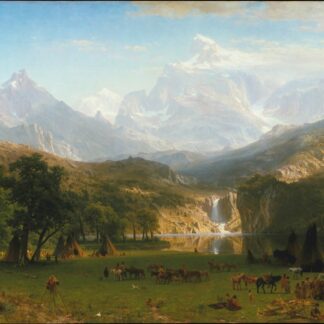
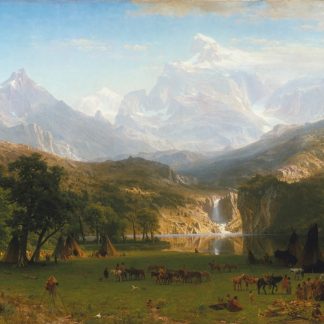
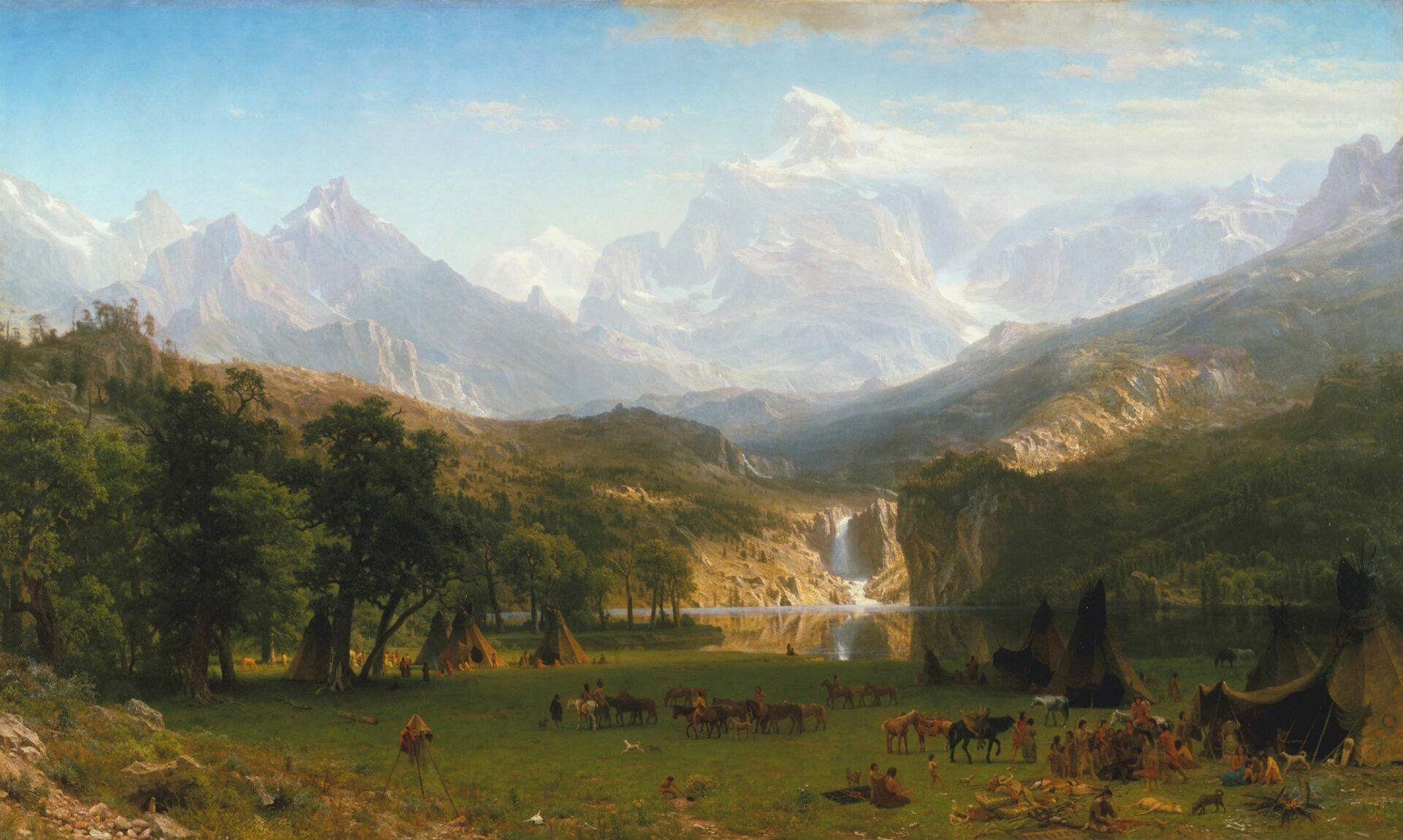
The Rocky Mountains, Lander’s Peak by Albert Bierstadt unfolds from a shaded encampment beside a lake toward a vast range of luminous mountains. Tents, horses and small groups of people occupy the grassy foreground, while trees frame the water and a waterfall catches the light near the center. Pale, jagged summits rise beyond successive wooded slopes. The contrast between the intimate camp and the distant peaks makes the landscape feel immense without leaving it empty of human life.
Painted in 1863, the work grew out of Bierstadt’s journey with Frederick W. Lander’s survey expedition in 1859, which reached the Wind River Range in present-day Wyoming. Bierstadt completed the painting in New York after his return, transforming observations from his travels into a carefully composed panorama. It has been compared to and exhibited with Frederic Edwin Church’s The Heart of the Andes, and sold in 1865 for $25,000.
The Metropolitan Museum of Art identifies the foreground people as Shoshone and places the painting within the period’s ideology of Manifest Destiny. Its magnificent prospect helped present the West as a frontier for settlers, even though Indigenous communities already lived there. That history gives the encampment significance beyond its role in establishing scale. Visually, the dark trees, still lake and bright waterfall lead toward peaks softened by cloud and atmosphere. Bierstadt’s arrangement joins detailed foreground activity with an idealized distance, making the painting both a spectacular landscape and a historically situated vision of the American West.
Read our guide to giclée prints, browse more Albert Bierstadt prints, or explore A Storm in the Rocky Mountains, Mt. Rosalie.