Description
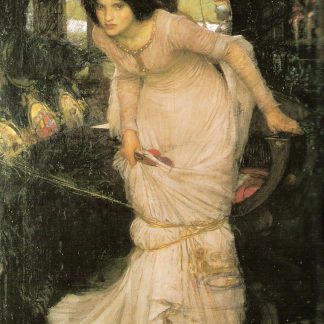
The Lady of Shalot Looking at Lancelot by John William Waterhouse captures a sudden break in the heroine’s secluded life. She leans forward in a pale, flowing dress, with loose threads stretching across the room and winding around her body. Behind her, a large round mirror contains the reflected image of Lancelot riding past outside. Bright glimpses of the world beyond interrupt the dark interior, drawing attention to the distance between her enclosed room and the life she longs to experience.
The subject comes from Alfred, Lord Tennyson’s poem The Lady of Shalott. Confined to her tower under a mysterious curse, the Lady watches the outside world through a mirror and weaves its reflected scenes into a tapestry. When Lancelot passes, she leaves her loom and turns to look directly toward Camelot. In the poem, the web flies loose and the mirror cracks, announcing that the curse has taken effect. Waterhouse concentrates these events into a moment of interrupted work and irreversible movement.
The painting gives this literary turning point a physical intensity. Her luminous dress and intent face stand out against the shadowed furnishings, while the tangled threads make the abandoned weaving seem to reach after her. The cracked mirror brings the reflected world and her sheltered existence into the same fragile surface. Lancelot remains a distant presence within that reflection, while her posture carries the immediate drama. Longing, confinement and the consequences of looking become part of the room’s dense arrangement of fabric, light and movement.
Read our guide to giclée prints, browse more John William Waterhouse prints, or explore The Lady of Shalott.