Description
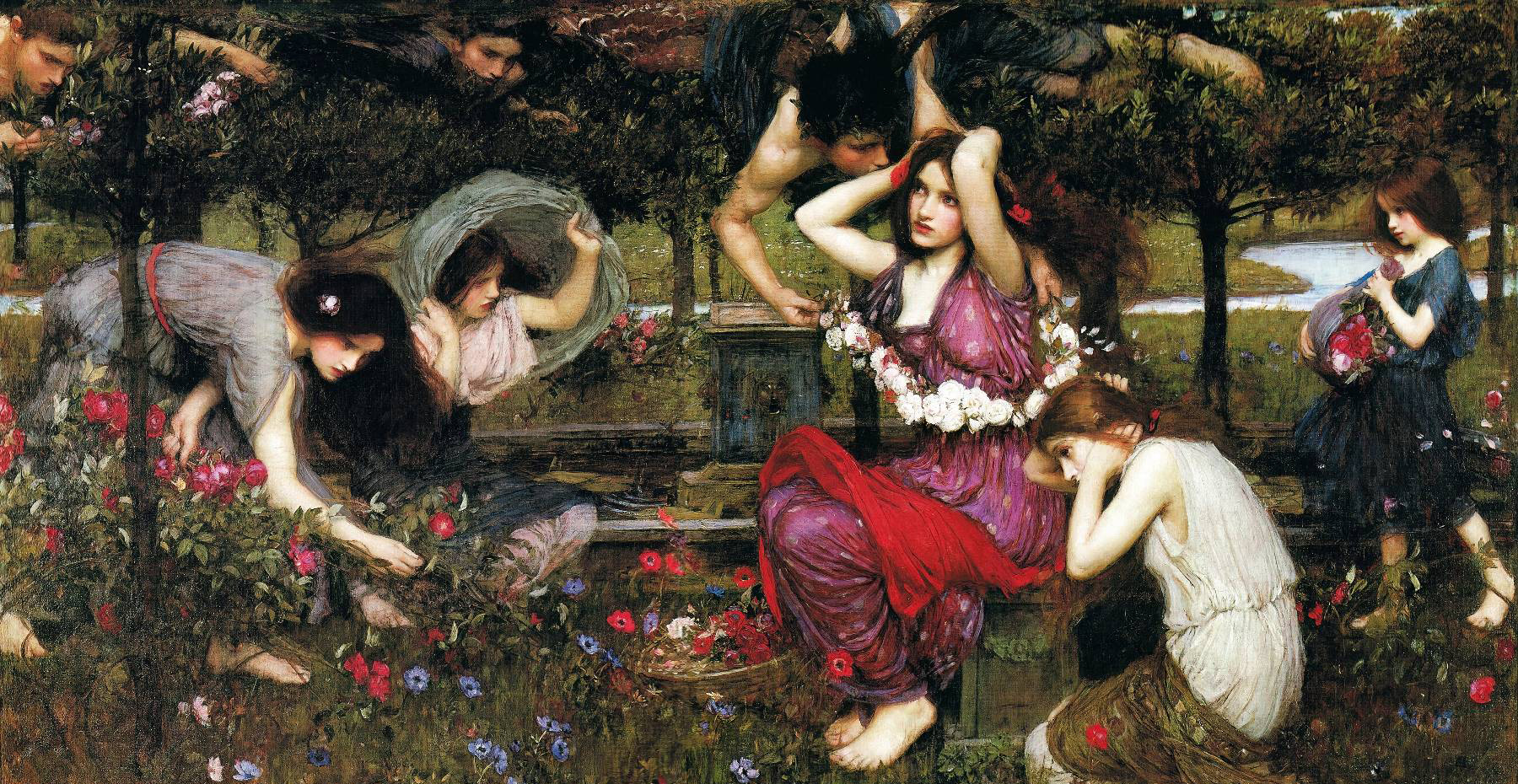
Flora and the Zephyrs by John William Waterhouse places the Roman goddess of flowers and spring at the center of a densely planted garden. Seated in purple drapery with red fabric across her lap, she raises both arms beside her head and looks toward a winged figure leaning down through the foliage. A garland of pale roses curves around her, while attendants gather and hold flowers on either side. The encounter fills the garden with intersecting gestures rather than leaving Flora as an isolated figure.
The painting draws on the classical story of Zephyrus, the west wind, and Chloris, the nymph who becomes Flora. Waterhouse’s treatment also recalls Botticelli’s Primavera, bringing mythology into a flower-strewn setting where human figures and the natural world closely overlap. Exhibited at the Royal Academy in 1898, the work presents the meeting through bodily movement and exchanged gazes. The wind spirits are given visible forms among the branches, making their arrival part of the garden’s immediate life.
Dark trees set off pale skin, white flowers and the rich folds of Flora’s clothing. At the left, a woman bends toward the blossoms while another lifts a translucent veil; at the right, gathered flowers and a lowered head continue the movement around the seated goddess. Water glimmers behind the figures, opening a lighter passage through the enclosed greenery. These changes of direction, texture and light reward close looking, giving the mythological scene an atmosphere that is both lush and unsettled.
Read our guide to giclée prints, browse more John William Waterhouse prints, or explore Ariadne.