
Composition VIII
Wassily Kandinsky‘s “Composition VIII” is a landmark of abstract art, painted in 1923. The painting is a symphony of color and form, characterized by its complex composition and dynamic energy. The piece is a testament to Kandinsky’s belief in the power of abstract art to convey emotion and spirituality.
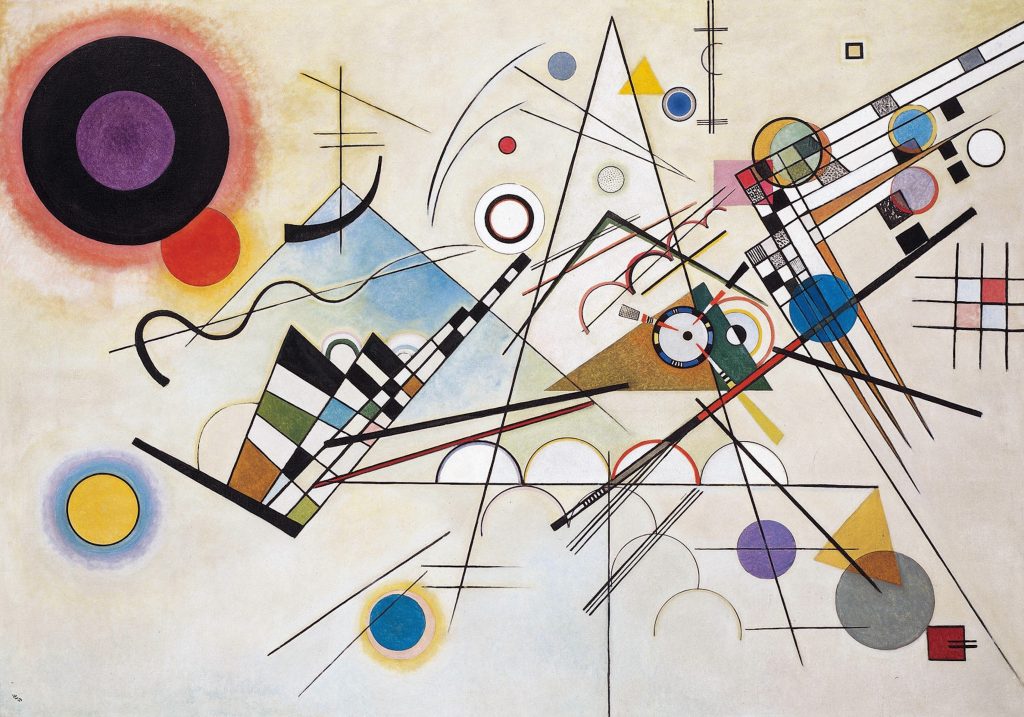
Circles, triangles, arcs and straight lines interact across a light background. Some shapes overlap, while others remain separated by open space. Their differences in scale, angle and color establish visual rhythms and tensions rather than dividing the canvas into a set of uniform compartments.
One of the most notable aspects of “Composition VIII” is the way that it emphasizes the emotional and spiritual power of abstract art. Kandinsky believed that abstract art had the ability to convey deep emotions and spiritual truths, and that it was capable of transcending the limitations of representational art. The dynamic, expressive forms of “Composition VIII” are a testament to this belief, as they convey a sense of energy and movement that is not tied to any particular subject or object.
Kandinsky painted Composition VIII during his Bauhaus years, when geometric forms became increasingly important in his work. His interest in music offers one way to approach the painting: contrasts and repetitions can be experienced like visual rhythms, without requiring each shape to stand for a particular object.
Kandinsky’s writings provide a basis for discussing the emotional and spiritual possibilities of color and form. They do not establish a single political message or a fixed symbolic meaning for every element of this painting. Viewers can explore its relationships of balance, contrast and movement without treating personal associations as documented intentions.
In conclusion, “Composition VIII” is a masterpiece of abstract art, notable for its complex composition, bold use of color, and emotional and spiritual power. The painting is a testament to Kandinsky’s belief in the transformative power of art and its ability to elevate the human spirit. It continues to fascinate and inspire new generations of artists and art lovers to this day.