
Description
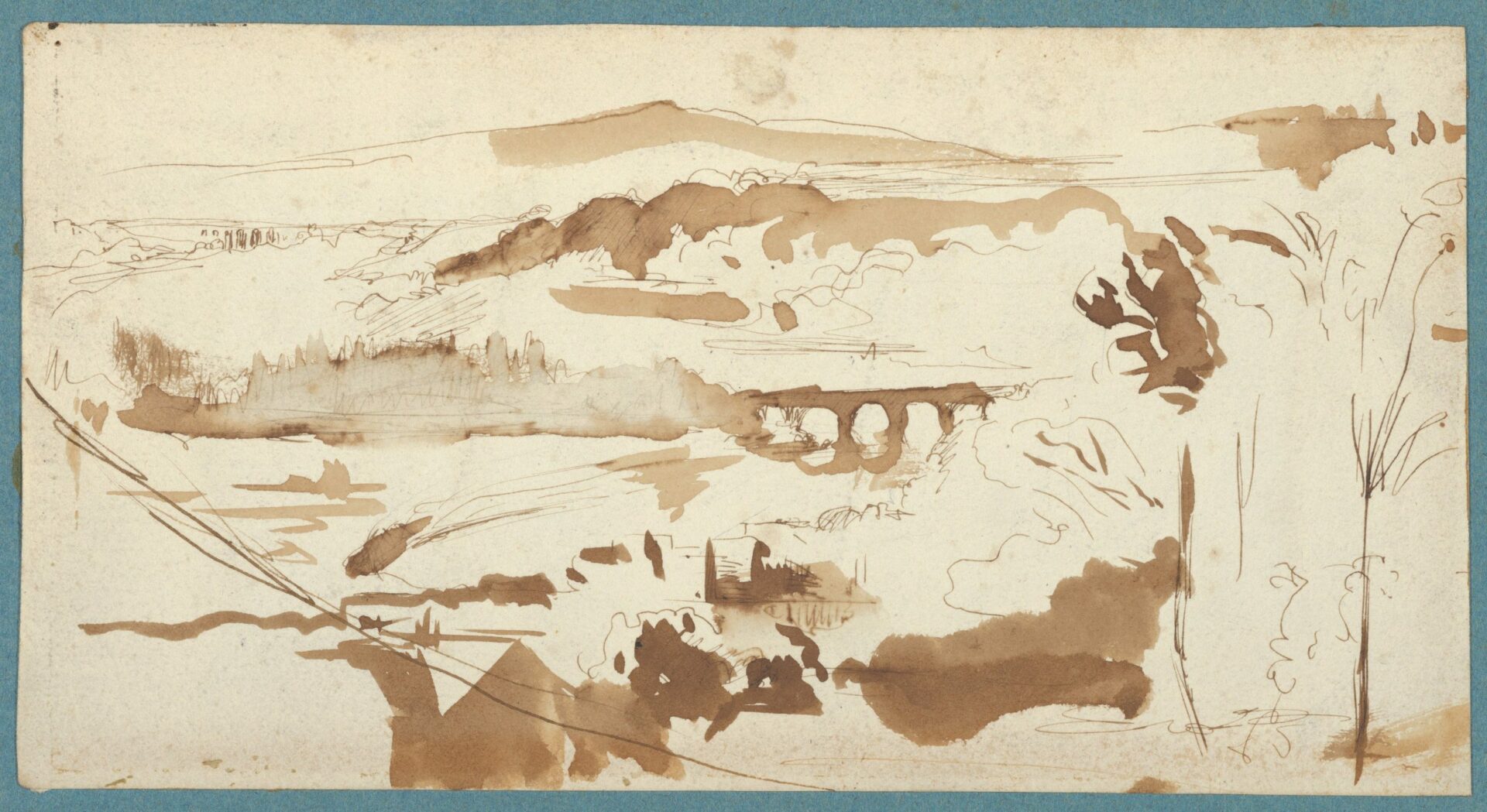
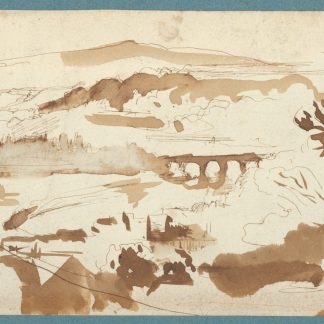
Eugène Delacroix spreads hills and an aqueduct across a landscape drawn in warm brown tones. Horizontal arches appear toward the middle left, while darker structures near the foreground give depth to the wider view. Water or open ground creates intervals between the built forms, allowing architecture and terrain to participate in a spacious, connected setting.
Made around 1827, the drawing combines pen and brown ink with brush and brown wash. Delacroix balances the aqueduct’s repeated structure against the broader, less regular forms of the hills, giving the scene different rhythms. Darker accents guide the eye through the foreground without closing the view beyond. The work invites attention to a landscape shaped by both natural space and human construction, where an architectural line can help make distance readable.
Read our guide to giclée prints or browse the Eugène Delacroix collection.
Reviews
There are no reviews yet.