

Description
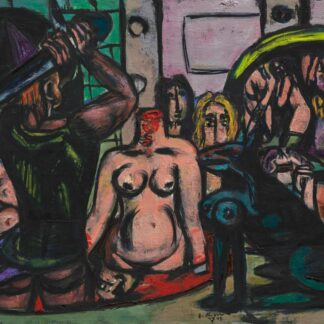
Max Beckmann’s Perseus’s Last Duty, painted in 1949, gathers strongly outlined figures into a densely colored, unsettling scene. A pale nude occupies the center, flanked by an armored figure and dark, compressed forms whose relationship is difficult to resolve at a glance. The title invokes a classical hero, but the museum identifies the scene as an invention rather than an episode found in the ancient Perseus myth.
The painting’s symbols remain deliberately enigmatic, and its meaning cannot be reduced to a single fixed story. Beckmann’s arrangement gives destruction a theatrical immediacy, setting the viewer among forms that feel pressed together and emotionally charged. The museum describes the work as a suggestive critique of human destructiveness. That reading preserves its broader force without pretending to decode every detail. The picture asks the viewer to confront what is visible while leaving its private symbolic relationships unsettled.
Read our guide to giclée prints or browse the Max Beckmann collection.
Reviews
There are no reviews yet.