
Description
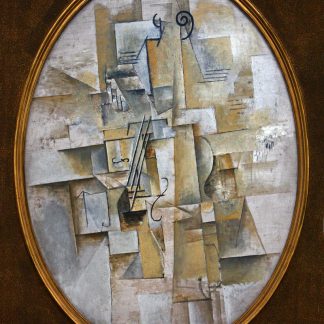
In Violin, Picasso draws the eye into a network of small surfaces and dark lines. Ochre, brown, and gray fragments gather toward the middle of the oval composition, then loosen toward its edges. The instrument appears through scattered clues rather than a complete outline: suggestions of strings, a curled neck, and the body’s curves emerge from the surrounding structure. Recognition happens gradually, as the eye tests one fragment against another.
Painted in 1911–12, the work is an example of analytical Cubism. Picasso breaks the violin apart and brings different views into the same shallow space, replacing a single perspective with overlapping information. The limited palette makes these changes of direction easier to follow. Music provides the subject, but the picture’s rhythm is visual: repeated angles, short accents, and curved interruptions give the surface a taut and intricate balance.