Goya, Francisco de
Browse Francisco de Goya giclée prints, including scenes from Los Caprichos, the Disasters of War and the Disparates, alongside drawings and paintings. Each product page lists the available materials and sizes. Our guide to giclée prints explains the paper and canvas options.
Explore the Goya collection
- Out Hunting for Teeth — Los Caprichos
- Animal Folly — Disparates
- Blind Guitarist — everyday life
- Seated Giant — imagination and shadow
- The Third of May — painting
About Francisco de Goya
Francisco de Goya was a Spanish painter and printmaker who lived from 1746 to 1828. He is considered one of the most important artists of the late 18th and early 19th centuries, and his work had a profound influence on the development of modern art. Goya began his artistic career as a painter of portraits and religious works, but he soon became known for his skillful use of light and shadow, as well as his bold, unconventional compositions.
Goya’s work is marked by its emotional intensity and its critical engagement with the social and political issues of his time. He was deeply influenced by the Enlightenment, and his works often reflect a skepticism towards religious and political authority. Some of his most famous works include “The Third of May 1808,” which depicts the execution of Spanish citizens by French soldiers, and “The Black Paintings,” a series of murals that he painted on the walls of his home in Madrid towards the end of his life.
Goya’s legacy has endured through the centuries, and his works continue to inspire and challenge viewers with their raw emotion and incisive social commentary. He is now considered one of the most important painters in the history of Western art, and his influence can be seen in the work of many later artists, including the Impressionists and Expressionists.
Browsing Goya, Francisco de. Search and filters below narrow this collection. Clear all resets those choices. Shop all products
Subject (0 selected)
Setting (0 selected)
Theme & activity (0 selected)
Place (0 selected)
Style & tradition (0 selected)
397 results


Plate 61 from 'Los Caprichos': They have flown (Volaverunt.)

Plate 55 from 'Los Caprichos': Until death' (Hasta la muerte.)

Plate 59 from 'Los Caprichos': And still they don't go! (Y aun no se van!)

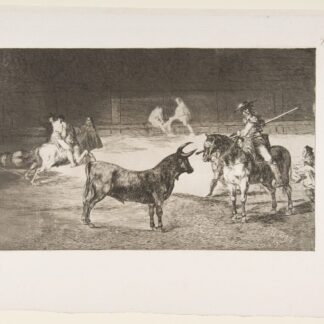
Plate 27 from the 'Tauromaquia': The celebrated picador, Fernando del Toro, draws the fierce beast on with his pike

Plate 23 from the 'Tauromaquia': Mariano Ceballos, alias the Indian, kills the bull from his horse.
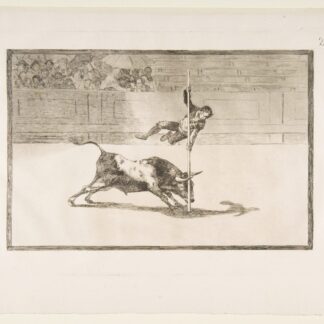
![Plate 20 from the 'Tauromaquia':The agility and audacity of Juanito Apiñani in [the ring] at Madrid.](https://www.trgfineart.com/wp-content/uploads/2022/07/TRG-PRINT-2037-paper-a96a8b82dbdc4542-324x324.jpg)
Plate 20 from the 'Tauromaquia':The agility and audacity of Juanito Apiñani in [the ring] at Madrid.

Plate 15 from the 'Tauromaquia': The famous Martincho places the banderillas playing the bull with the movement of his body.

Plate 12 from the 'Tauromaquia': The crowd hamstrings the bull with lances, sickles, banderillas and other arms.

Plate 10 from 'La Tauromaquia': Charles V spearing a bull in the ring at Valladolid

Plate 6 from 'The Tauromaquia': The Moors make a different play in the ring calling the bull with their burnous.

Plate 5 from 'The Disasters of War' (Los Desastres de la Guerra): 'And they are like wild beasts.' (Y son fieras.)

Plate 26 from 'The Disasters of War' (Los Desastres de la Guerra): 'One can't look.' (No se puede mirar.)

Plate 72 from 'The Disasters of War' (Los Desastres de la Guerra): 'The Consequences.' (Las resultas.)

Plate 60 from 'The Disasters of War' (Los Desastres de la Guerra): 'There is no one to help them.' (No hay quien los socorra.)

Plate 37 from 'The Disasters of War' (Los Desastres de La Guerra): 'This is worse.' (Esto es peor.)

Plate 47 from 'The Disasters of War' (Los Desastres de la Guerra): 'This is how it happened.' (Así sucedió.)

Plate 10 from 'Los Caprichos': Love and death (El amor y la muerte)

Plate 34 from 'Los Caprichos': Sleep overcomes them (Las rinde el Sueño.)

Plate 66 from 'Los Caprichos':There it goes (Allá vá eso.)

Plate 32 from 'Los Caprichos': Because she was susceptible (Por que fue sensible.)

Plate 31 from 'Los Caprichos': She prays for her (Ruega por ella.)

Plate 17 from 'Los Caprichos': It is nicely stretched (Bien tirada está.)

Plate 15 from 'Los Caprichos': A pretty piece of advice (Bellos consejos)